Choose timezone
Your profile timezone:
The Kobayashi-Maskawa Institute (KMI), Nagoya University will host the 7th KMI International Symposium on “Quest for the Origin of Particles and the Universe” (KMI2026) from November 9 to 11, 2026.
The symposium aims to review the current status and future prospects of cutting-edge research in particle physics, astrophysics, cosmology, and related fields, and to promote interdisciplinary collaboration across these areas.
This year's symposium will also serve as the Kick-off Meeting for the Dark Matter International Research Center (DarMa), established within KMI. DarMa brings together researchers in particle physics, astrophysics, and cosmology to advance interdisciplinary approaches to the dark matter problem.
November 9 (Mon) - 11 (Wed), 2026
The scientific program will consist of invited talks on recent theoretical and experimental achievements and future prospects in the following areas:
Sessions dedicated to the DarMa kick-off meeting will also be organized. (The timetables are in preparation.)
ES Hall, the ground floor of the Engineer and Science (ES) Building, Nagoya University, Higashiyama Campus
The venue is marked as C2-4 on the map of Higashiyama Campus
J. Ellis (King’s College London), S. Iso (KEK), T. Kajita (ICRR), H. Murayama (UC Berkeley), M. Sasaki (IPMU), J. Silk (IAP), S. Asai (KEK)
T. Iijima (Chair), H. Tajima (Co-chair), M. Yamashita (Co-chair), S. Akama, S. Dey, M. Harada, M. Hartz, J. Hisano, Y. Horii, K. Ichiki, S. Iguro, K. Inami, A. Ishibashi, K. Izumi, S. Izumiyama, M. Kitaguchi, K. Kuwahara, N. Maekawa, M. A. Merchand Medina, H. Menjo, V. M. Mikuni, H. Miyatake, H. Murakami, Y. Nakamura, T. Nakano, K. Nakazawa, K. Osuga, P. K. Rados, S. Saga, T. Sakai, H. M. Shimizu, T. Shiromizu, D. Suenaga, N. Sugiyama, T. Sunayama, K. Suzuki, S. Takahashi, M. Tanabashi, F. Tarsitano, T. Terada, K. Tobe, Z. Yan, S. Yokoyama, C. Yoo
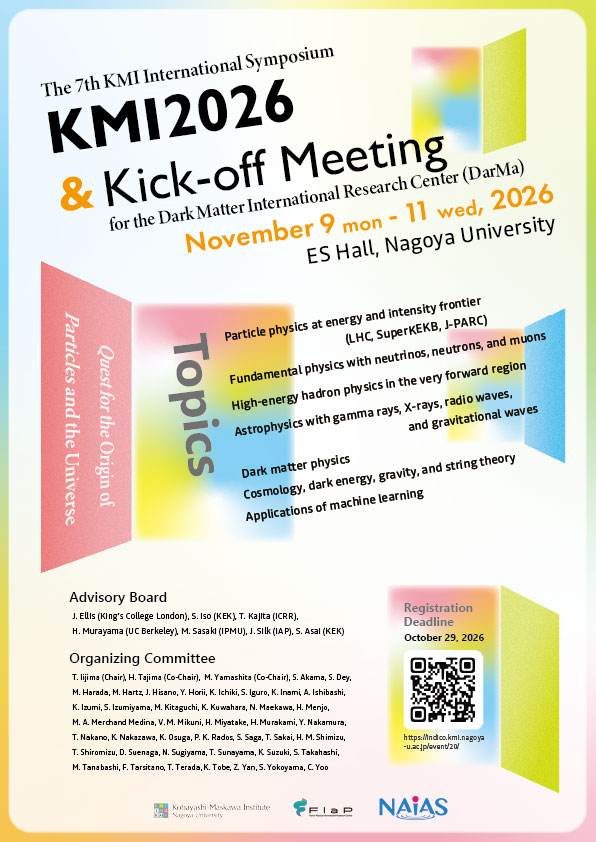
Flyer/Poster is available here (kmi2026.pdf)
In this talk, I will briefly review the current status of semileptonic $b \to s\ell\ell$ governed transitions, with particular emphasis on theoretical uncertainties. The main goal is to present two complementary strategies for discovering New Physics while simultaneously ruling out hadronic effects as a viable explanation of the $B$-anomalies. Belle II will play a major role in both approaches. The first strategy focuses on $b \to s\tau\tau$ transitions and their correlations with $b\to c \tau\nu$ and $b\to s \nu \bar{\nu}$ ones within SMEFT under various New Physics scenarios. The second strategy relies on a novel class of observables that exploit the different sensitivities of exclusive and inclusive decay modes to hadronic effects. Finally, I will briefly discuss some recent ideas and novel observables for non-leptonic $B$ decays.
The Belle II experiment at the SuperKEKB collider pursues a broad program of precision measurements in flavor physics and searches for physics beyond the Standard Model. As the recorded dataset approaches 1 ab-1, improvements in accelerator and detector operation are enabling sustained data collection at high luminosity.
This talk will review the current status of SuperKEKB and Belle II and highlight selected physics results, with particular emphasis on tau-lepton physics, to which the KMI group makes significant contributions. Operation progress and challenges at higher luminosity will also be discussed.
This presentation focuses on lattice QCD calculations for precision studies of the muon anomalous magnetic moment (muon g-2). I will begin with a brief review of the current status, as summarized in the Whitepaper. In the main part, I will present recent high-precision lattice QCD determinations of the muon g-2, highlighting the Mainz/CLS and BMW results, and compare them with experimental measurements and dispersive determinations. These comparisons reveal tensions among theoretical estimates of the hadronic vacuum polarization (HVP) contribution. I will then turn to the running QED and electroweak couplings, which also depend on the HVP, and discuss how these tensions manifest themselves in these quantities. Finally, I will present preliminary results from the PACS collaboration for the two-pion scattering length. This gives a first step toward achieving precise control over the pion sector, which is essential for precision calculations of the muon g-2.
The muon anomalous magnetic moment, aμ = (gμ − 2)/2, and electric dipole moment (EDM) are powerful probes of physics beyond the Standard Model (SM). The final result from the Fermilab Muon g−2 experiment has established a new benchmark for precision tests of the SM. While the latest lattice-QCD-based prediction agrees with the experimental value, discrepancies between different theoretical approaches remain unresolved. An independent measurement is therefore important for further testing the muon anomalous magnetic moment.
The J-PARC muon g−2/EDM experiment aims to measure aμ and search for the muon EDM using a novel approach distinct from those employed by the BNL E821 and Fermilab E989 experiments. The experiment utilizes a low-emittance muon beam produced through thermal muonium formation and laser ionization. The muons are subsequently reaccelerated and injected into a compact storage magnet using a three-dimensional spiral injection scheme.
Following the first demonstration of muon cooling and acceleration, we have recently succeeded in accelerating cooled muons to 0.3 MeV in the dedicated experimental area at J-PARC. In this talk, we will present the experimental concept, recent progress in the development of key components, and future prospects toward precision measurements of the muon g−2 and EDM.
This talk presents recent precision measurements of key properties of the Higgs boson by the ATLAS and CMS Collaborations. Results presented use proton-proton collisions at √s = 13 TeV and 13.6 TeV collected during Run 2 and Run 3, respectively, of the LHC. Highlights on Higgs cross sections, couplings and di-Higgs searches will be discussed.
This presentation provides an overview of the ATLAS upgrades for the HL-LHC and the contributions of the Kobayashi-Maskawa Institute (KMI) at Nagoya University. LHC data-taking ended in June 2026, and a major upgrade of the ATLAS experiment is underway in preparation for the start of HL-LHC operations in 2030. To cope with the increased instantaneous luminosity, several detector components and systems will be upgraded, including the inner detector, the innermost layers of the muon spectrometer, and the trigger and data acquisition system. KMI has played a leading role in developing the on-detector electronics for the Thin Gap Chambers and the Level-1 muon trigger system, and continues to contribute to their upgrades.
The nature of dark matter remains one of the most fundamental mysteries in particle physics and cosmology. After briefly reviewing the evidence for dark matter and representative candidates, including axions, weakly interacting massive particles (WIMPs), and primordial black holes, I will focus on light dark matter with masses broadly between those of conventional axions and WIMPs.
The talk will cover two main aspects: theoretical motivations and experimental searches. For the former, I will discuss possible connections between light dark matter and the origin of neutrino masses and mixing. For the latter, I will highlight recent developments in MeV gamma-ray observations, direct detection experiments, and searches for light mediators at high-intensity accelerators, particularly in the context of thermal dark matter scenarios.
Cosmological and astrophysical observations across all length scales provide clear evidence that there is five times more mass in the universe in the form of exotic dark matter than there is normal matter. Candidates for dark matter are discussed across a wide range of mass scales, from wave-like axion-like particles to primordial black holes. The GeV to TeV mass range, with WIMPs as candidates, continues to be regarded as particularly promising. Detectors filled with liquid noble gases, particularly xenon, have been leading the field for over two decades.
This talk will report on the field of direct search for dark matter search. Particular emphasis will be placed on the WIMP search using the XENON experiment and its planned successor detector, XLZD. Owing to their enormous sensitivity and the low number of background events – due to the location of the detectors, which weigh several tonnes, in underground laboratories and the extremely low levels of radioactivity – these detectors have evolved into observatories for the search for very rare events and for physics beyond the Standard Model. They are yielding many exciting additional results, particularly in the field of neutrino physics.
Direction-sensitive detection of dark matter provides a powerful way to explore its nature, although obtaining directional information remains challenging due to the low energy of expected signals. The Nano Imaging Tracker (NIT), a super-fine-grained nuclear emulsion, enables the detection of low-energy particles with nanometric track resolution, offering advantages in background discrimination and signal identification.
This talk will focus on low-energy proton tracks as a new approach to directional searches for MeV-scale dark matter. In particular, boosted dark matter scenarios are promising, as their signals can retain directional information pointing toward the Galactic Center. We will introduce multi-component boosted dark matter models and present recent activities of the NEWSdm experiment.
Cosmic probes of small scale structure are an important frontier in our effort to understand the nature of dark matter, because these probes are sensitive to deviations from the CDM paradigm. Several valuable probes are found in our own galaxy, the Milky Way. These include dwarf galaxies and stellar streams, which are developing rapidly as probes, with ground-based astronomical observations playing an important role.
I will describe how these stellar structures are being used to constrain the nature of dark matter, describing the methods used, their challenges, current status, and future prospects.
In this talk, I will discuss recent progress in understanding the critical conditions for primordial black hole (PBH) formation in the early Universe.
After the astrophysical neutrinos are discovered by IceCube, follow-up observations by ground-based gamma-ray telescopes have started aiming for co-generation sites of neutrinos and gamma rays. Even with the anticipated success of IC170922A/TXS 0506+056 (by instruments such as MAGIC telescopes), trials to find more similar cases have not been successful. Meanwhile, the discoveries of neutrinos from Seyfert galaxies and Galactic plane gave us another mystery of neutrino counterparts. The gamma-ray follow-ups therefore should get updated, according to the newest knowledge of the possible neutrino emitters.
At the same time, the instruments should get updated as well, such as CTAO LST, which will act as the successor of MAGIC, and IceCube-Gen2, which is naturally that of IceCube. In this contribution these updates of follow-up strategies and multi-messenger instruments will be briefly introduced.
To interpret the results of dark matter direct detection experiments, the local dark matter density and velocity distribution are important inputs. They are estimated from observations or from cosmological simulations. In cosmological simulations, the estimates can depend on how Milky Way-like galaxies are selected and solar-neighborhood-like regions are extracted. In this study, we use the public TNG50 data of the IllustrisTNG project, selecting disc stars from their positions and local stellar density and extracting the dark matter particles around them. We compare the results with those obtained under less stringent criteria for galaxy selection and solar-neighborhood extraction.
We investigate whether primordial CMB B-mode polarization improves constraints on the cubic three-torus (E1) topology. Using full harmonic-space covariance matrices of temperature, E-mode, and primordial B-mode anisotropies, we evaluate Gaussian likelihoods in an ideal cosmic-variance-limited case. We find that adding B-mode polarization provides only marginal improvement in distinguishing E1 from the trivial topology, due to the interplay between transfer-function responses and topology-induced off-diagonal correlations.
Primordial magnetic fields (PMFs) may have been generated during inflation or cosmological phase transitions in the early Universe. They are among the leading candidates for the origin of magnetic fields suggested to exist in cosmic voids.
PMFs present at recombination can generate additional density fluctuations that may seed structure formation. Lorentz forces acting on the residual ionized component drive gas motions, producing these fluctuations.
In this study, we incorporate PMF-induced perturbations into the standard inflationary perturbation framework. Using cosmological magnetohydrodynamical (MHD) simulations, we investigate the evolution of density fluctuations and magnetic fields. We also quantitatively evaluate the thermal evolution of the gas and discuss the implications of PMFs for cosmic evolution.
One of the goals of FASERν detector at the CERN-LHC is to test lepton flavor universality by measuring charm production in interactions of all three neutrino flavors. For this measurement, secondary hadronic interactions are a one of the major backgrounds to charm identification.
In this study, we analyze pion-W hadronic interactions at 50–300 GeV using 2024 test beam data and compare the results with six simulation models. We also report on an additional test beam experiment conducted in summer 2026.
Determining the shape of the Higgs potential is essential for assessing the stability of the vacuum, establishing how electroweak symmetry is broken, and searching for new physics. The measurement of the trilinear Higgs self-coupling lambda_HHH is the key, and Higgs boson pair production (HH) is the only process with direct sensitivity to it.
The HH to 4b final state, in which both Higgs bosons decay to b-quark pairs, has the largest branching ratio and is one of the most sensitive channels.
Improving the performance of b-jet identification (b-tagging) is essential for increasing the sensitivity of this analysis. At the ATLAS experiment, the introduction of transformers and related algorithms has substantially improved b-jet identification in the offline analysis. Collecting HH to 4b events with high efficiency requires event selection with b-jet triggers at the online stage. Because of latency constraints, the online environment and the offline analysis differ in the b-tagging algorithms that can be used and in the detector information that is available. Scale factors (SFs) that correct the differences in identification efficiency between data and simulation must therefore be derived, taking proper account of the differences between the online and offline efficiencies and of their correlation.
In this work, the search sensitivity to non-resonant HH to 4b is evaluated with these trigger SFs taken into account, and the impact of the statistical and systematic uncertainties of the SFs on the sensitivity and on the allowed region of lambda_HHH is assessed. This poster shows the impact of these trigger-calibration results on the search sensitivity.
Using the d log integrand construction in de Sitter (dS) space, we obtain
the canonical differential equations of the massless bubble correlator family in dimensional regularization, together with analytic boundary conditions. This is equivalent to giving the analytic solution of this family in terms of multiple polylogarithms to arbitrary order
in ϵ.
Charm tagging is expected to play an important role in searches for new physics with charm quarks in the final state, and the choice of tagging working point, defined by the trade-off between the charm-jet efficiency and the rejection of b- and light-flavour jets, affects the search sensitivity. We evaluate this effect using leptoquark searches as a case study. Leptoquark exchange, for example by an R₂-type leptoquark, gives rise to final states both without jets, such as c s̄ → μν, and with a charm jet, such as g s → c μν. Signal and Standard Model background events at √s = 13 TeV are generated with MadGraph5_aMC@NLO and Pythia8 and simulated with Delphes. We vary the working point based on recent ATLAS charm-tagging benchmarks and compare the expected sensitivity with and without charm tagging.
In $AdS_3/CFT_2$, the gravity sector includes not only supergravitons but also states involving singletons. In our previous work, we studied the construction of this gravity sector in the D1-D5 CFT at $N=2$. In this talk, we extend the analysis to general $N$. We also investigate the lifting of BPS states under deformations away from the free orbifold point. This talk is based on ongoing work with Marcel R. R. Hughes, Daiki Matsumoto, and Masaki Shigemori.
Deep underground laboratories provide the low-background environments essential for rare-event searches in physics. The Bedretto tunnel, situated beneath the Gotthard massif in Switzerland, provides the opportunity to establish such a facility, with an overburden of up to 4000 metres water equivalent. Already hosting the Bedretto Geology Laboratory operated by ETH Zurich, the site benefits from horizontal access and convenient proximity to Zurich and Milan, facilitating detector development, commissioning, and experimental operation. We present results from a measurement campaign in an unlined rock cavern, characterising the underground environment through measurements of cosmic-ray muon, neutron, and gamma fluxes, the radon concentration, and the vibrational and electromagnetic noise. These measurements provide a first assessment of the site’s suitability for low-background experiments. We outline the foreseen development of the facility, including the installation of dedicated underground infrastructure. We also present plans for the deployment of an underground microscopy facility that can be used for rare-event searches using passive crystal detectors.
I development a tube finding algorithm using only drift tube hits.
Nuclear emulsion is a photographic film that records charged-particle tracks in three dimensions with sub-micron spatial resolution. It is used in a wide range of experiments, including neutrino experiments and cosmic gamma-ray observations. After each experiment, the tracks recorded in all the films must be read out into digital data with optical microscope systems. HTS-2 is currently the world’s fastest nuclear emulsion scanning system. With the conventional imaging method, which we brought into full-scale operation and reported at KMI2025, it has reached a processing capacity of 1,000 m² of film per year. Larger experiments with far more film are being planned for more precise physics measurements, and scanning speed is their bottleneck. We are therefore developing a new imaging method, continuous tomographic imaging, in which the emulsion is imaged tomographically while the stage moves continuously. It has already demonstrated readout 2.4 times faster than the method now in operation and is about to enter routine operation. This poster presents the latest status of this development.
We investigate domain-wall quintessence as a potential explanation for the accelerated expansion of the Universe. Using cosmic microwave background (CMB) and Type Ia supernova observations, we constrain the anisotropic expansion induced by one Hubble scale domain wall. Our analysis shows that CMB temperature multipoles, particularly the quadrupole, impose stringent constraints on the domain-wall energy density. And supernova data results strongly disfavor domain walls as the dominant source of cosmic acceleration, favoring the ΛCDM limit.
The ATLAS endcap muon trigger system is being upgraded for the HL-LHC. The Sector Logic (SL) board processes hit data from TGC detectors to reconstruct muon trigger candidates. The SL board integrates a Virtex UltraScale+ XCVU13P FPGA for trigger processing, a Mercury XU5 MPSoC module for system control, and a CERN-IPMC for power management and monitoring.
The SL boards were manufactured with several design improvements over the previous prototype, including modifications to the power-sequencing circuit. We performed functional tests and measurements and confirmed the expected operation of the board-management functions and the revised power-sequencing circuit.
KMISCT (KMI Science Communication Team) is a student-led outreach organization composed of undergraduate and graduate students interested in particle physics, astrophysics, and related fields. The team provides opportunities for students to engage in science communication while promoting public interest in frontier research.
KMISCT organizes a variety of outreach activities both on and off campus. These include exhibits and hands-on demonstrations at university events such as the Nagoya University Festival and Homecoming Day, participation in science events at museums and public venues, collaborations with external organizations, and the production of a YouTube podcast series. These activities are planned and operated primarily by students, providing young researchers with opportunities to communicate scientific ideas directly to audiences of diverse ages and backgrounds.
This poster introduces the structure and activities of KMISCT and highlights representative outreach programs. Beyond communicating scientific knowledge, KMISCT serves as a platform where students develop the skills needed to engage with society as future researchers. We discuss the opportunities and challenges of student-led science communication and share lessons learned through a wide range of public engagement activities.
Inelastic dark matter provides a well-motivated extension to the standard WIMP paradigm, in which scattering proceeds through a transition to a heavier dark sector state. Such scenarios arise naturally in several models of physics beyond the Standard Model, including nearly pure Higgsino dark matter, where small mass splittings suppress elastic interactions while leaving inelastic scattering experimentally accessible. Liquid xenon (LXe) time projection chambers (TPCs), have become the leading technology for rare-event searches owing to their excellent energy resolution, scalability, and powerful background discrimination. Building on the success of its predecessors, XENONnT operates a multi-ton dual-phase LXeTPC with exceptionally low background levels, enabling searches for dark matter and other rare interactions. Following the collaboration's recent search for magnetic and spin-independent inelastic dark matter in the conventional WIMP region of interest, this work describes a dedicated search for inelastic dark matter with XENONnT targeting a broader signal phase space. The analysis being developed explores a wide range of dark matter masses and mass splittings, accounting for the distinctive kinematic features introduced by the inelastic transition, such as the modified recoil spectra and an enhanced dependence on the high-velocity component of the Galactic dark matter halo, motivating dedicated signal and background modeling, and optimized event selection across a large region of interest.
The discovery of T_cc+ has motivated further studies of doubly heavy tetraquarks. The bottom–charm system T_bc offers a way to explore how heavy-quark masses and interactions between meson channels shape exotic hadrons. We investigate this system in a coupled-channel hadronic molecular model, using an interaction constrained by T_cc+. This poster presents our preliminary study of the T_bc spectrum and discusses its relevance to future experimental searches.
The Belle II experiment aims to search for physics beyond the Standard Model by producing a large number of B meson pairs with the SuperKEKB accelerator and precisely measuring rare decays and CP violation. The TOP (Time-Of-Propagation) counter is the particle identification detector in the barrel region of Belle II, which distinguishes kaons from pions using the time of arrival and position of Cherenkov photons. In this study, we develop an identification method based on a graph neural network (GNN), which takes the detected Cherenkov photons as input, aiming to improve the K/π identification performance. Currently, we are constructing and training the GNN model using Belle II Monte Carlo simulation data, and comparing its identification performance with that of the conventional method. In this poster, we present an overview of the GNN-based identification method and the current results of its performance evaluation, and discuss future prospects, including the application of more advanced models such as the Particle Transformer and the application to real data.
The J-PARC muon g−2/EDM experiment aims to precisely measure the muon anomalous magnetic moment and electric dipole moment using a low-emittance muon beam. Characterization of the longitudinal bunch structure is important for the development of the muon linear accelerator.
We developed a bunch width monitor (BWM) using a microchannel plate (MCP) detector to measure the time structure of accelerated muons. In June 2026, a beam test was conducted in the H2 area at J-PARC, where cooled muons were successfully accelerated to 0.3 MeV for the first time in this area.
Using the BWM, we observed the expected microbunch structure of muons accelerated by a 324 MHz radio-frequency quadrupole (RFQ). The relative populations of the microbunches showed a dependence on the RFQ phase, consistent with the trends predicted by simulations. The measured main-bunch width was also comparable in scale to the simulation results, although quantitative differences remain under investigation.
This poster presents the measurement of the accelerated muon bunch structure and its comparison with simulations.
Originally motivated for the generation of (Majorana) neutrino masses, the Type-II Seesaw Model has also a rich extended Higgs sector with a distinctive phenomenology of neutral, charged and doubly-charged states. In this presentation we will show an exhaustive phenomenological study of the most promising production and decay channels of pair or associated Higgs scalars, decaying to gauge bosons or in cascades. The signal optimization study using DNN for searching these Higgs bosons with the LHC-ATLAS Run 3 data will be presented, as well as some preliminary results.
I evaluated the RPC detection efficiency
Toward n-pentane-free TGCs, a TGC is run with CO₂ only: its operating window is narrow and sensitive to the environment. With cosmic rays and Garfield++, the gain is set by an effective HV, V_eff = V × (T/T₀) × (P₀/P): 0.69 ± 0.05 %/V vs 0.63 ± 0.07 %/V. Derived the effective-HV correction for P and T, which enables HV settings that keep the gain constant.
Quantum entanglement in the initial state of primordial perturbations can leave characteristic imprints on cosmological correlation functions.
In this work, using the Schrödinger wave-functional formalism, we incorporate quantum entanglement through a Gaussian initial state with quadratic mixing between different polarization modes, and study its impact on the primordial tensor power spectra.
We will first conduct our analysis within general relativity and then extend it to parity-violating gravitational theories in which the left- and right-handed tensor modes evolve differently.
This allows us to investigate whether a chiral asymmetry in their primordial power spectra can be amplified by the effects of quantum entanglement.
We investigate the helical primordial magnetic fields that can be generated by parity-violating interactions such as the axion-U(1) interaction in the early Universe. The primordial magnetic fields could leave their imprints on the superhorizon perturbation, such as curvature perturbations and gravitational waves. Motivated by that, we calculate the parity-violating trispectrum from the perturbations induced from helical primordial magnetic fields. We discuss how large the parity-odd signals of the trispectrum show in Fourier space and how the trispectrum depends on the parameter that indicates helicity asymmetry of primordial magnetic fields. We also give some implications for the parameter and the strength of primordial magnetic fields from observation of cosmic microwave background.
The Belle II experiment at the SuperKEKB electron–positron collider provides a uniquely clean, high-luminosity environment for searching for dark-sector particles and long-lived particles (LLPs) predicted by extensions of the Standard Model. Operating at the intensity frontier, Belle II is particularly sensitive to low-mass LLPs in the MeV–GeV range with macroscopic lifetimes, including those produced in heavy-flavour decays.
This talk will present an overview of LLP search strategies at Belle and Belle II, highlighting recent results from the Belle experiment on searches for heavy neutral leptons (HNLs) arXiv:2402.02580. I will discuss strategies for searching for long-lived neutralinos in B-meson decays at Belle II, motivated by our recent phenomenological study arXiv:2507.00359, and the ongoing experimental efforts to investigate these scenarios. The talk will also cover searches for other exotic signatures, including heavy QCD axions, and discuss the potential of Belle II to probe a broader range of new-physics scenarios beyond the Standard Model.
The seed to the observed massive quasars is likely mesoscale black holes formed in the radiation-dominated era. This work investigates continuous collapse of a superhorizon scale photon fluid to a growing compact region. By introducing self-similar variables, we simplify the nonlinear dynamical equations in the presence of Hubble expansion. Such a solution that may describe the infant stage of a quasar is presented.
Symmetric teleparallel gravity describes gravity in terms of nonmetricity rather than curvature or torsion. One of its remarkable features is that general relativity can be reformulated equivalently using nonmetricity, providing a natural framework for exploring extensions of general relativity and possible new gravitational phenomena.
In this work, we focus on parity violation in symmetric teleparallel gravity and consider parity-violating corrections constructed from nonmetricity, including higher-derivative terms. Using cosmological perturbation theory, we investigate the stability of perturbations by analyzing the kinetic structure of the quadratic action. In particular, vector perturbations are of special interest because, although they are nondynamical in general relativity, they can become dynamical degrees of freedom in symmetric teleparallel gravity. We therefore analyze the quadratic action for vector perturbations in parity-violating symmetric teleparallel gravity and investigate the conditions required for their stability.
Large liquid xenon (LXe) detectors have become a leading technology in rare-event searches, including direct dark matter detection and searches for neutrinoless double beta decay.
A significant source of background in these experiments arises from the radioactive progeny of 222Rn, a noble gas that can emanate from detector surfaces. To achieve the target sensitivities of next-generation experiments such as XLZD, further radon mitigation techniques will be needed.
A novel radon mitigation technique based on electrochemically deposited surface coatings has recently been developed at the Max Planck Institute for Nuclear Physics (MPIK) in Heidelberg, achieving a thousandfold reduction in radon emanation from stainless steel samples. This work investigates the application of this technique in a large-scale liquid xenon detector, as well as its compatibility with the stringent radiopurity requirements of LXe detectors and its long-term stability under cryogenic operating conditions.
The coating is applied in collaboration with MPIK and evaluated in Xenoscope, a 2.6-m-long dual-phase time projection chamber (TPC) operated at the University of Zurich, which provides a representative environment for large-scale LXe detectors.
This contribution presents the current status of the coating and its validation in Xenoscope.
We address the problem of reconstructing the initial density field of the universe by applying differentiable simulation techniques. We implement pmwd (Particle-Mesh with Derivatives), an adjoint-based differentiable N-body framework, to recover the primordial density field from evolved large-scale structures at redshift z = 0 obtained from the Indra simulation. Our reconstructions show excellent agreement with target fields derived from the WMAP7 cosmological model. Moreover, through reverse time integration, we recover the density field at higher redshifts (z = 10). With iterative refinement of the initial conditions, we improved the accuracy of the forward simulations, leading to a closer alignment with the observed density field. We also find that although the final density field is accurately reproduced, at certain small scales the correlation with true initial conditions does not improve further, where non-uniqueness of underlying information becomes dominant.
These results demonstrate the capability of differentiable programming in cosmological analysis and the viability of using machine learning and gradient-based optimization to extract precise initial conditions from large-scale structure data.
The Cosmic Dark Ages, the period before the formation of the first stars, remain largely unexplored by direct observations. Observations of the neutral hydrogen 21 cm line from this epoch provide a unique opportunity to test the standard cosmological model and investigate the formation history of the first stars. However, observations of the highly redshifted 21 cm signal at low radio frequencies are extremely challenging due to the Earth's ionosphere, human-made radio frequency interference (RFI), and the strong Galactic foreground emission.
TREED project aims to detect the 21 cm spectrum from the early Universe, approximately 100 million years after the Big Bang, using a low-frequency radio telescope aboard a small satellite orbiting the Moon. By utilizing the Moon as a natural shield against terrestrial RFI and operating beyond the Earth's ionosphere, TREED will enable low-frequency observations that are difficult or impossible from the ground. In addition, a variable-length antenna is being developed to achieve broadband observations. In this presentation, we introduce the scientific objectives and observational concept of TREED, along with the current status of the satellite and instrument development.
Density fluctuations in the early universe grew into the large-scale structure we see today. Galaxy clusters are the largest objects in this structure, and most of their mass is dark matter. We can measure their total mass with weak gravitational lensing, in which the gravity of a cluster distorts the shapes of background galaxies. The Local Volume Complete Cluster Survey (LoVoCCS) aims to build a precise mass–X-ray luminosity relation for 144 nearby X-ray selected clusters (0.03 < z < 0.12) observed with Subaru Hyper Suprime-Cam (HSC) and DECam. So far, 28 clusters have been observed with HSC in the g, r, i, and z bands.
For weak lensing, it is important to use only background galaxies. However, photometric redshifts are not reliable for galaxies in nearby clusters. Without the u band, many red-sequence galaxies in the cluster get redshifts that are too high, and they enter the background sample. Because these galaxies are not lensed, they weaken the lensing signal. To solve this problem, we select background galaxies by their colors and magnitudes and remove the red sequence. With this color selection, the stacked lensing signal becomes stronger near the cluster center.
We show how this selection changes the estimated mass and concentration of the clusters.
The neutral Wino is a well-motivated dark matter candidate, but its spin-independent scattering off nucleons is strongly suppressed by a cancellation between different contributions. A precise prediction therefore requires careful control of QCD corrections. In the previous next-to-leading order (NLO) analysis, the contributions of the third-generation quarks were neglected and treated only as an uncertainty. We complete this analysis by computing the third-generation NLO contributions with the full top-quark mass dependence.
The XLZD (XENON-LUX-ZEPLIN-DARWIN) collaboration aims to develop a next-generation liquid xenon observatory for dark matter and rare-event searches, with a target mass of 60–80 tonnes. Scaling up dual-phase time projection chambers to these dimensions presents several technical challenges, including the transport of ionization electrons over longer drift distances.
Xenoscope, a large-scale vertical LXe demonstrator at the University of Zurich, provides a platform to investigate these challenges. The facility contains approximately 360 kg of LXe and features a 2.6 m-long dual-phase time projection chamber. Electron drift over distances exceeding 2 m has recently been successfully demonstrated using ionization electrons produced by atmospheric muons.
This contribution gives an overview of the Xenoscope facility and presents the latest results from the long-drift measurements.
Understanding interactions among hadrons is an important step toward revealing the nonperturbative dynamics of the strong interaction. Hadron interactions also play an essential role in the formation of hadronic molecules and other exotic hadrons. Traditionally, hadron interactions have been studied through scattering experiments. However, such experiments are applicable to only a limited number of hadron pairs, and experimental information is particularly scarce in the low-energy region.
In recent years, several new approaches have opened up opportunities to investigate hadron interactions that were previously difficult to access. Among them, the femtoscopy technique, which studies momentum correlations of particle pairs produced in high-energy collisions, has become a powerful tool for exploring low-energy hadron interactions. Combined with theoretical analyses of correlation functions, high-precision experimental data provide quantitative information on interactions involving unstable or short-lived hadrons, for which conventional scattering experiments are difficult or impossible.
In this talk, recent progress in the study of hadron interactions will be reviewed, with particular emphasis on the femtoscopy technique. The basic idea of extracting hadron interactions from two-particle correlation functions and recent applications to various hadronic systems will be discussed. These developments will be placed in the broader context of modern studies of hadron interactions, including high-precision scattering experiments such as the J-PARC E40 experiment and first-principles calculations based on lattice QCD. The complementary roles of these approaches and future prospects for the study of hadron interactions will also be discussed.
The origin of the nucleon mass is a fundamental problem of quantum
chromodynamics. In the parity doublet model (PDM), the nucleon and its negative-parity partner share a chiral invariant mass $m_0$, which survives chiral symmetry restoration, while the chiral condensate generates their mass splitting.
We review recent progress in constraining chiral invariant mass $m_0$ from neutron star observations.
The Belle II experiment is collecting data in Run 2 at SuperKEKB, the world's highest-luminosity asymmetric-energy $e^+e^-$ collider, in Tsukuba, Japan. The experiment has also conducted an energy scan to study exotic states such as the $Y(10753)$ and $B^{(*)}\bar{B}^{(*)}$ production, and the analysis of the collected data is underway.
In this presentation, we will discuss recent results and ongoing studies.
I will review searches for dark matter conducted at LHC experiments and B factories.
The LHC forward (LHCf) and RHIC forward (RHICf) experiments performed very forward measurements at zero degree of LHC and RHIC collisions to test hadronic interaction models used for cosmic-ray air shower simulations.
In this presentation, the recent results from these experiments will be presented such as very forward photon measurement at LHC proton-Oxygen collisions.
The FASERν experiment at the CERN Large Hadron Collider (LHC) has opened a new window on neutrino physics at TeV energies. Using a nuclear emulsion detector, FASERν achieved the first direct observation of collider neutrinos and measured their interaction cross sections in a previously unexplored energy regime.
With the completion of LHC Run 3, FASERν has accumulated nuclear emulsion data corresponding to an integrated luminosity of 240 fb⁻¹, offering unprecedented opportunities to explore neutrino interactions and forward particle production.
In this talk, I will present the status of Run 3 data analysis, highlighting the contributions of Nagoya University. I will also discuss future prospects, including FASERν in Run 4 and next-generation neutrino experiments at the Forward Physics Facility (FPF).
Neutron–antineutron oscillations, which change baryon number by two units, are predicted by theories beyond the Standard Model. In experimental searches using ultra-cold neutrons (UCNs), knowledge of antineutron–nucleus scattering lengths is essential for improving the sensitivity.
This talk will present plans for an antineutron experiment at CERN and discuss a prospect of oscillation searches using UCNs.
Neutron is suitable for the precision measurement for fundamental physics. Combination of the instantaneously luminous neutrons and the advanced neutron optical devices enables us to perform new types of high precision measurements. We have been actively conducting experiments that use nuclear reactions as a probe to search for the violation of time reversal symmetry. Experiments utilizing the wave nature of slow neutrons are also making progress. The present status and future prospect of neutron physics in Japan will be reported.
Indirect searches aim to detect signatures of dark matter interactions through various cosmic messengers. They provide unique opportunities to probe dark matter, particularly in the heavy mass range, while careful analyses are required to interpret observational results.
In this talk, I will present an overview of the achievements of indirect dark matter searches to date and their prospects, including connections with other search strategies.
The GRAINE project aims to observe cosmic gamma rays using a balloon-borne telescope based on nuclear emulsion films, covering the energy range from 10 MeV to 100 GeV with high angular resolution (1° at 100 MeV and 0.1° at 1 GeV) and sensitivity to gamma-ray polarization.
We present an overview of the GRAINE experiment and the latest results from our fourth balloon flight, conducted in 2023. We investigated the Galactic center GeV excess observed by Fermi-LAT and derived a new upper limit on the gamma-ray flux associated with the excess in the 100–300 MeV energy range within a region of interest (ROI) of radius 1° centered on the Galactic center. Our upper limit is consistent with both an astrophysical origin, such as millisecond pulsars, and a dark matter origin. The gamma-ray flux attributed to the excess by Fermi-LAT in this energy range is subject to substantial uncertainties, primarily arising from the diffuse gamma-ray emission model. Our result provides an independent constraint on the excess, taking advantage of the high angular resolution of our detector.
The Compton Spectrometer and Imager (COSI) is a Small Explorer satellite mission selected by NASA and scheduled to launch in August 2027. COSI employs a novel Compton telescope consisting of a compact array of cross-strip germanium detectors. Utilizing its wide field of view and excellent energy resolution, COSI will perform an all-sky survey in the 0.2–5 MeV band and achieve uniform exposure over the sky.
In this talk, I will give an overview of the COSI project and its current status, and describe the MeV gamma-ray astrophysics it will enable, including imaging, spectroscopy, and polarimetry.
XRISM provides unprecedented energy resolution spectroscopy especially around Fe-K emission line energies. After its launch on 2023, XRISM has revealed many new insights into dynamics and physical status of objects such as compact objects, SMBHs, SNRs, and cluster of galaxies. In this talk, we will review the state of the art information on cluster physics revealed by XRISM.
Since the first detection of gravitational waves in 2015, gravitational-wave observatories have transformed our understanding of the Universe through observations of compact binary mergers. These scientific achievements have been driven by continuous advances in detector technology.
This talk reviews the major discoveries of the first decade of gravitational-wave astronomy, together with the evolution and upgrades of gravitational-wave detectors. I will also introduce current research and development activities at Nagoya University directed toward future generations of gravitational-wave observatories.
The weak gravitational lensing effect of the cosmic large-scale structure, also known as cosmic shear, was first detected in the year 2000. Since then, increasingly ambitious surveys have been conducted to use this tool to test the standard model of cosmology and, in particular, reveal the physical nature of dark energy and gravity. We are currently at the threshold between stage III and stage IV experiments that will increase the signal-to-noise ratio from ~100 to ~1000 before the end of this decade.
This talk will review the theory behind cosmic shear, its main advantages over other cosmological probes, and the most important systematic errors that need to be controlled. A short historical overview and the final results from KiDS (Kilo-Degree Survey) and DES (Dark Energy Survey) will be presented before providing an outlook on the potentially groundbreaking first results from the Euclid space mission that will be released in the coming year as well as the upcoming Rubin Observatory Legacy Survey of Space and Time (LSST) and Roman Space Telescope.
In 2000, cosmic shear, namely the gravitational lensing effect generated by the large-scale structure, was first measured by photometric galaxy surveys. Since then, it has been playing an increasingly important role in modern cosmology, providing tight constraints on the matter density parameter (Omega_m) and fluctuation amplitude parameter (S8). With the improvement in image quality, sky coverage, and survey depth, tensions have emerged between the S8 constraints from galaxy surveys and the CMB survey by the Planck satellite. Combined analysis of cosmic shear, galaxy-galaxy lensing, and galaxy clustering from recent "Stage-III" surveys (KiDS, DES, and HSC), namely the 3x2pt, has confirmed this tension to a significance of ~3sigma. The final cosmic shear results from the Kilo-Degree Survey (KiDS), however, show consistency with Planck (0.73σ), driven largely by improved redshift calibration. This highlights the critical role of redshift calibration in future surveys. To further improve precision, a 6×2pt analysis has been proposed, combining correlations among galaxy positions and shapes from photometric surveys and galaxy positions from spectroscopic surveys. This approach strengthens cosmological constraints while mitigating redshift uncertainties through self-calibration. A key challenge for 6×2pt analyses is the variable depth of photometric galaxy samples, caused by non-uniform selection effects. It introduces an additional correlation signal and bias in parameter constraints. By applying an unsupervised machine learning method, we can obtain "organized randoms" that can account for the selection effects. In this talk, I will review the current status of cosmology with galaxy surveys, with an emphasis on cosmic shear and 6×2pt analyses using KiDS-Legacy data. These efforts set the stage for upcoming Stage-IV surveys and promise to sharpen our understanding of the Universe.
Imaging surveys with narrow and medium-band filter sets have long provided an efficient way of increasing the spectral resolution over traditional broad-band surveys in selective wavelength ranges. These surveys have a significant impact in diverse cosmology and astrophysics studies; e.g., they enable sensitive surveys for low-bias cosmological tracers across a wide range of redshift; searches for the earliest generations of stars; maps of the interstellar, circum-galactic and intergalactic medium; and provide targets for our spectroscopic surveys. I will describe past, on-going and future narrow/medium-band surveys, focusing on the new wide-area medium-band surveys underway to enable Run 2 of the Dark Energy Spectroscopic Instrument.
Defects and boundaries appear throughout physics, from Wilson lines in gauge theories and impurities in condensed matter systems to branes in string theory. Defect conformal field theory (DCFT) describes such extended objects in critical systems, using the symmetry that remains after the defect is introduced.
In this talk, I will give an overview of recent developments in DCFT, including defect RG flows and holographic realizations. I will then discuss defect CFTs at finite temperature, where new data, such as thermal one-point functions, appear and provide a new probe of DCFTs.
Massive spin-2 particles arise naturally in models with extra dimensions. For their 2->2 scattering amplitudes, we constrain the allowed form of the interactions using dispersion relations based on unitarity and causality, assuming a separation between their mass and the higher-spin (J>=3) scale that signals a breakdown of effective field theory. To control the explosion in the number of tensor structures with increasing spin, we employ superconvergence relations and novel "dual" amplitudes. Using these techniques, we show that the three-point couplings are constrained to the Einstein–Hilbert form up to small corrections. We also study the implications for the light particle spectrum.
The standard paradigm of the early universe is single-field inflation with the Bunch-Davies initial vacuum state and conserved superhorizon perturbations. Although quantum fluctuations predicted by this framework can be consistent with current observational constraints, alternative scenarios beyond this paradigm have also been actively explored. Investigating potential deviations in their observational signatures is therefore essential for distinguishing between different paradigms of the early universe.
In this talk, I focus on primordial non-Gaussianities. Maldacena’s consistency relation constrains squeezed-limit bispectra in single-field models with standard initial vacuum conditions and conserved superhorizon perturbations, limiting enhancements beyond the standard prediction. Consequently, a substantial enhancement of squeezed-limit bispectra would provide a distinctive probe of physics beyond the standard paradigm. Recently, such enhancements have been shown to potentially leave observable imprints on the anisotropies of the gravitational wave background (GWB).
After reviewing Maldacena’s consistency relation, I discuss two examples of non-standard paradigms within Horndeski gravity: inflation with non-Bunch-Davies states but conserved superhorizon perturbations, and a bouncing cosmology with growing superhorizon perturbations but standard initial vacuum conditions. I then discuss the possible enhancements of the tensor squeezed bispectra in these scenarios, their implications for GWB anisotropies, and the prospects for probing these paradigms with space-based gravitational-wave interferometers such as LISA and BBO/DECIGO. Finally, I discuss the broader potential of GWB anisotropies as a probe of early-universe physics beyond the specific scenarios considered in this talk.
I will show the latest physics results from the Super-Kamiokande experiment, highlighting the recent claim on the diffuse supernova neutrino background, and the current construction status of the Hyper-Kamiokande experiment.
The XENONnT experiment aims to investigate astroparticle physics using a dual-phase time projection chamber containing 5.9 tonnes of active liquid xenon, operated at the Laboratori Nazionali del Gran Sasso (LNGS) in Italy. Although the primary goal of the experiment is the direct detection of dark matter, low-energy solar neutrino physics is also one of its important physics targets.
Thanks to extensive efforts to achieve an extremely low radioactive background, together with dedicated calibrations and analysis techniques, the XENONnT detector is now sensitive to elastic neutrino-electron scattering induced by solar neutrinos at the keV scale, reaching the statistical significance of 5-sigma.
In this talk, I will present an overview of the XENONnT experiment and the first measurement of low-energy solar neutrinos with XENONnT.
In recent years, studies of neutrino–nucleus interactions have become an urgent and important research topic for investigating CP violation in the neutrino sector. We are conducting the NINJA experiment, in which nuclear emulsion detectors, offering exceptionally high spatial resolution, are installed in the J-PARC Neutrino Monitor Building and operated in a hybrid configuration with the T2K near detectors. In this presentation, we will report on the latest physics results and experimental R&D activities. We will also introduce recent developments in neutrino research using nuclear emulsion.
AI agents can now read the literature, carry out derivations and numerical calculations, and write draft papers. Over the past six months I have used them in my own research.
In this talk I describe what this looks like in practice, with examples from my projects. I also discuss how to check what the agents produce. In one case, on hot Yang–Mills theory at θ = π, all of the checks written by the AI passed, but the answer was wrong. A different AI model found the error. Finally, I comment on what remains hard for the human side, in particular understanding the results.
Modern astronomical surveys are measuring millions to billions of galaxies, and artificial intelligence is rapidly becoming essential to exploit them. AI’s ability to extract subtle signals from high-dimensional, often incomplete data can give us a new window onto the Universe. One window we need to open is onto dark matter, which dominates cosmic structure but can only be observed indirectly. Galaxies form within gravitationally bound clumps of dark matter, called halos, and serve as their luminous tracers. Decoding the connection between galaxies and their host halos lets us probe both the dark matter distribution and the physics of galaxy formation.
This talk focuses on learning the dark matter signals hidden in galaxy environments, beyond what is captured by traditional summary statistics. I will discuss the role of simulations in uncovering these signals and present a machine-learning-based tool for inferring the properties of an observed galaxy’s host dark matter halo. I will then highlight ongoing and potential survey applications for this tool, as well as its place in the growing AI landscape in astrophysics and cosmology.
I'll review AI/ML/DL used for experimental collider physics, in particular, the LHC-ATLAS experiment. Also I'll show recent research activities in our group using LLM etc.
This presentation will provide an overview of the activities of the Next Generation Trigger project in ATLAS and focus on some specific examples of the use of fast Machine Learning to improve the trigger performance.
Discovery in the physical sciences relies on inverse engineering of observations. The combination of deep learning and physics-driven designs reforms the solution of inverse problems for extracting physical properties from complex data.
This talk explores physics-driven inverse modeling from a probabilistic perspective, emphasizing its application to hadron physics and lattice field theories. Generative diffusion models are introduced for inverse modeling of physical probability distributions, building scalable and transferable generators in equilibrium and non-equilibrium systems.
宇宙のどこかでは、ブラックホールや超新星爆発など、人類がまだ十分に理解できていない極めて激しい現象が起きています。その謎を解き明かす手がかりの一つが、宇宙から飛来する「ニュートリノ」です。
南極の氷の中に設置された巨大ニュートリノ望遠鏡 IceCube は、これまで観測が難しかった高エネルギー宇宙ニュートリノの検出に成功し、新たな宇宙観測の窓を切り開いてきました。しかし、その実現までの道のりは決して平坦なものではありませんでした。
本講演は、2026年ノーベル物理学賞を記念し、IceCube実験に参加する日本唯一の研究機関である千葉大学ICEHAPの吉田滋氏をお招きして開催します。IceCubeの建設初期から高エネルギー宇宙ニュートリノの初観測、そしてマルチメッセンジャー天文学の幕開けに至るまでの、まさに「紆余曲折の道のり」を、中核的な役割を担ってきた研究者の視点から語っていただきます。